
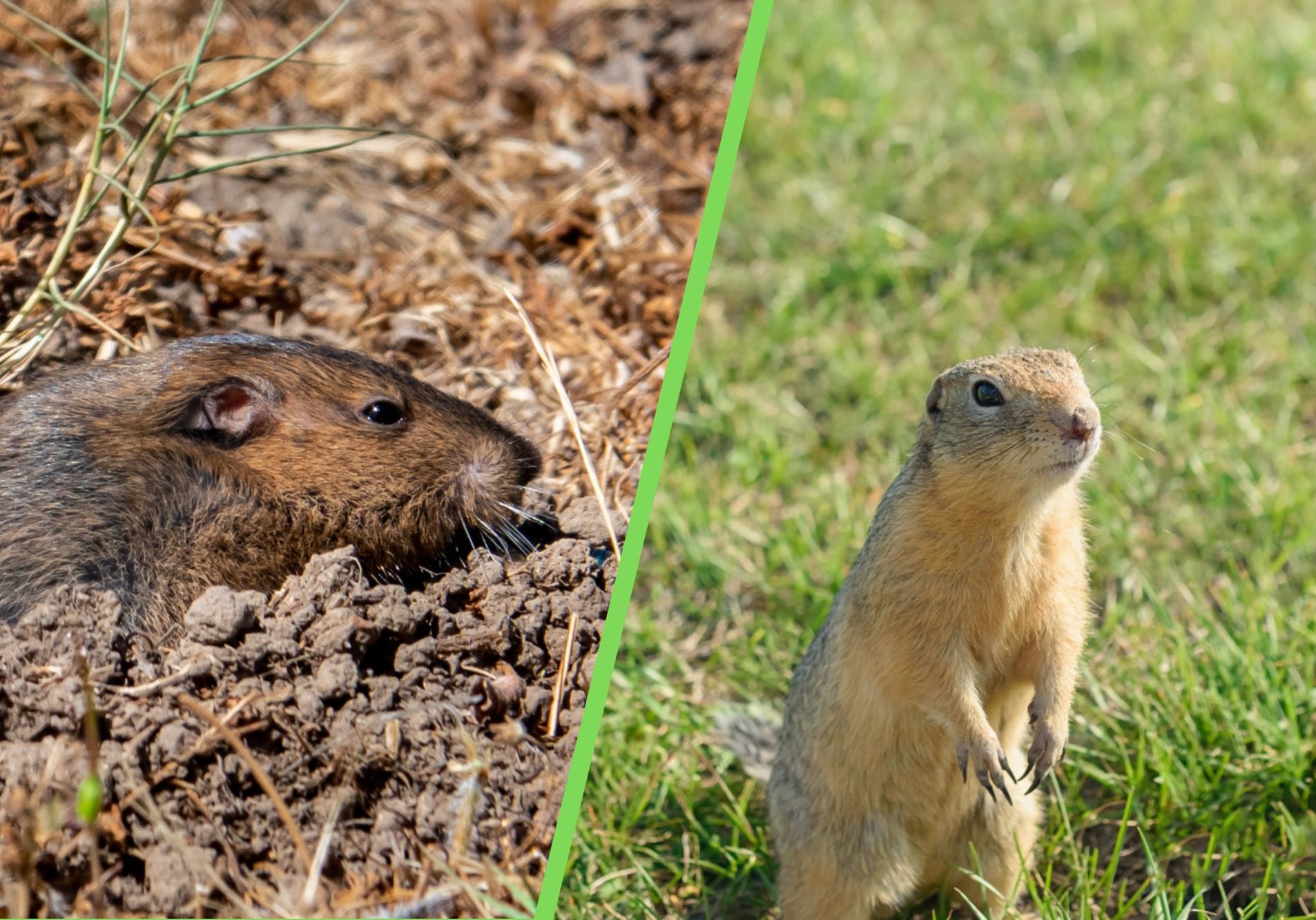
Pocket gophers vs. ground squirrels: What farmers need to know How to tell what’s tearing up your field before you waste time treating the wrong pest.
You’ve got fresh dirt in the field, crop damage is showing up, and something is digging.
The first question isn’t how you’re going to kill it.
It’s what exactly are you dealing with?
Pocket gophers and ground squirrels are different animals with different habits and different burrow systems. To make things more confusing, farmers in some parts of the U.S. and Canada routinely call ground squirrels “gophers.”
That matters because the wrong identification can send you down the wrong path with trapping, baiting, fumigation or field equipment while the crop keeps taking damage.
The quickest way to tell a pocket gopher from a ground squirrel
Pocket gophers spend almost all their time underground. Ground squirrels spend plenty of time aboveground.
That’s usually the fastest distinction.
If you regularly see the animal running, feeding or standing near an open burrow, you’re probably looking at a ground squirrel.
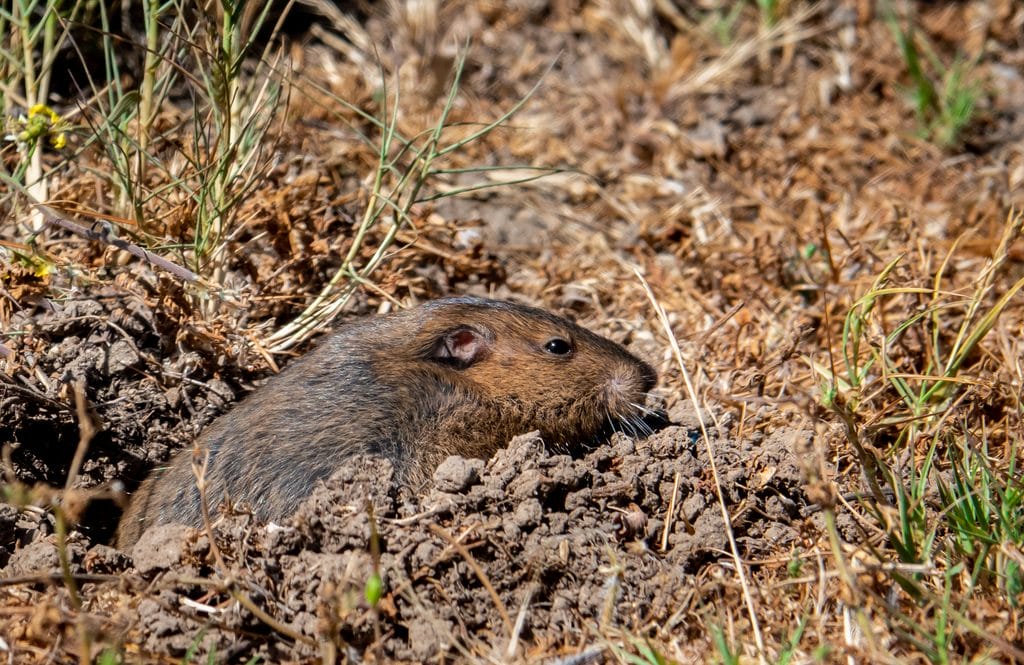
Pocket gophers are harder to catch in the act. Usually, you see what they leave behind: fresh dirt mounds and plugged tunnels.
| What you see | Pocket gopher | Ground squirrel |
|---|---|---|
| Body | Stocky and built for digging | Looks much more like a typical squirrel |
| Tail | Short with little hair | Longer and hairier |
| Front feet | Large digging claws | Less specialized for digging |
| Aboveground activity | Rare | Common |
| Burrow entrance | Usually plugged | Usually open |
| Dirt | Often fan- or crescent-shaped mounds | Dirt around obvious burrow entrances |
| Behavior | Usually solitary | Often several animals using an area |
You don’t need to get close enough to inspect teeth or count toes. The hole, the dirt and whether you actually see the animal will usually tell you what you need to know.

“Gopher” can mean something different depending on where you farm
Ask three farmers what a “gopher” is and you may get three different answers.
In much of the northern Plains and Canadian Prairies, farmers commonly use gopher to mean a ground squirrel, especially Richardson’s ground squirrel. In other places, the same word usually means a true pocket gopher. Montana, Saskatchewan and Alberta agricultural resources all acknowledge that regional usage.
That matters because the animals don’t behave the same way.
A farmer in Saskatchewan talking about gophers may be describing ground squirrels running between open burrows. A farmer somewhere else may be talking about pocket gophers that stay almost entirely underground and leave fresh mounds behind.
Same word. Different animal. Different problem.
So don’t put too much weight on the name people use locally. Instead, read the field. Look at the burrows, the mounds, where the activity is concentrated and whether you’re actually seeing the animal aboveground.
That will tell you far more than the word “gopher” ever will.
Pocket gopher damage usually starts underground
Pocket gophers spend most of their lives below the surface, which is part of what makes them such a pain to control. By the time the damage is obvious aboveground, they may already be working through roots and extending their tunnel system underneath the crop.
In hay and alfalfa fields, pocket gophers can cause problems several ways:
- Lost time: every new mound means another problem somebody has to deal with.
- Root damage: feeding can thin stands and kill plants from below.
- Dirt in hay: fresh mounds can get picked up during harvest and increase ash content.
- Rough fields: mounds and tunnels make the ground harder on equipment.
- Buried infrastructure damage: tunneling can create problems around irrigation lines and other underground systems.

For farmers, the damage isn’t really the mound itself. It’s lost stand, lower hay quality, equipment wear and labor.
Those losses add up fast when the infestation keeps coming back season after season.
Fresh activity matters most. Pocket gopher mounds are commonly fan- or crescent-shaped, and the tunnel entrance is generally plugged back up with dirt.
If you knock down old mounds and new ones start appearing, something is still active underneath the field.
Ground squirrels leave a different kind of problem
Ground squirrels burrow, but they don’t live the same almost-entirely-underground life as pocket gophers.
Their entrances stay open because they regularly move between the burrow and the surface.
That usually gives you several clues:
- Open holes rather than plugged tunnel entrances
- Visible animals during the day
- Multiple squirrels using the same general area
- Activity along field edges, ditch banks, roadsides or adjoining ground
- Aboveground feeding in addition to burrow damage
Their burrows can also leave rough ground, interfere with harvesting and create headaches around irrigation systems and ditch banks.
If you’re standing there watching squirrels run in and out of open holes, that’s useful information.
Don’t treat those holes like pocket gopher tunnels just because somebody calls the animals “gophers.”
Don’t diagnose the pest from one pile of dirt
Fields don’t always look like textbook examples.
Rain can knock a mound down. Irrigation can change its shape. Equipment can flatten old activity. Different soil types leave different-looking piles.
Instead of betting everything on one clue, look for a pattern.
Signs that point toward pocket gophers:
- plugged tunnel entrances;
- fresh fan- or crescent-shaped mounds;
- little or no visible aboveground activity;
- damage scattered through the stand;
- fresh dirt showing up again after old mounds are knocked down.
Signs that point toward ground squirrels:
- open burrow entrances;
- squirrels visible aboveground;
- several animals using the same area;
- activity concentrated around field edges or adjoining habitat;
- obvious aboveground feeding.
And don’t assume you can only have one rodent problem.
You can have pocket gophers working through the crop while ground squirrels are established around the perimeter.
Control options for pocket gophers and ground squirrels
Once you know what you’re dealing with, the control options get a lot clearer.
There’s some overlap between the methods used for pocket gophers and ground squirrels. Both may be controlled with trapping, baiting or fumigation in the right situation. But the animals use the ground differently, so the way those methods are applied isn’t the same.
Pocket gopher control options
Pocket gopher control is mostly about reaching an animal you may never see.
Because they spend nearly all their time underground, the work happens in or around an active tunnel system.
Common options include:
- Trapping: Traps are placed in active tunnels and can work well when you know where the gopher is working. The downside is labor. Locating tunnels, setting traps and checking them can become a serious time commitment when you’re managing more than a handful of animals.
- Baiting: Gopher bait also has to reach an active tunnel. Finding the tunnel matters — putting bait into an old or backfilled run doesn’t do much good if the gopher never encounters it. Bait effectiveness can also depend on the product, placement and whether the animal takes it.
- Fumigation: Fumigation targets the underground environment rather than relying on the gopher to eat something. Gopher General takes that approach at field scale by creating a treatment tunnel and placing slow-release fumigant underground as the tractor moves through the field.
- Monitoring and follow-up: Whatever method you use, keep watching for fresh mounds. Pocket gophers are an ongoing management problem, particularly when untreated ground nearby keeps supplying new animals.
For farmers covering significant acreage, the amount of labor involved becomes part of the control decision. A method that works fine for a couple of gophers may be a different story when fresh mounds are showing up across an entire hay field.
Ground squirrel control options
Ground squirrels give you a different set of options because they regularly come aboveground and use open burrows.
Common control methods include:
- Trapping: Trapping can be practical when squirrel numbers are still relatively low. Once a population is well established across a large area, the labor requirement becomes a much bigger consideration.
- Baiting: Ground squirrel baiting targets their aboveground feeding behavior. Timing matters because what squirrels are eating changes through the season, and bait that’s attractive at one point may not be attractive at another. Species and region matter here, too, so follow the product label rather than assuming one baiting schedule applies everywhere.
- Burrow fumigation: Ground squirrel burrows can also be fumigated. This is different from the way Gopher General treats pocket gophers. Ground squirrel fumigation targets their existing open burrow systems, and effectiveness depends heavily on soil conditions, animal activity and the fumigant being used. Agricultural guidance generally favors fumigation when soil has enough moisture to hold the gas in the burrow.
- Managing the source of reinfestation: If squirrels are moving in from ditch banks, roadsides, rangeland or adjoining property, treating the animals inside the crop may only address part of the problem. Watch the perimeter and figure out where new activity is coming from.
That last point is especially important with ground squirrels. If you’re continually treating one side of a field while new animals keep moving in from the same neighboring ground, you can spend a lot of time fighting the symptom without getting ahead of the source.
The same method doesn’t mean the same treatment
Seeing baiting, trapping or fumigation listed for both animals can make them sound more interchangeable than they are.
They aren’t.
For pocket gophers, you’re dealing with a mostly closed underground tunnel system and an animal that rarely comes aboveground.
For ground squirrels, you’re dealing with open burrows and animals that regularly leave them to feed.
So before you buy a product or put equipment in the field, make sure three things line up:
- the animal you’re trying to control;
- the method you’re using;
- the product label and requirements where you farm.
That’s especially important with pesticides and fumigants. Approved products, target species and application requirements can vary, so the current label is the final authority.
The goal isn’t to throw every control method you have at the field. It’s to use the one that makes sense for the animal doing the damage.